 Security
Website backups on Armenian hosting: what hosts copy and how to test restoration
What Armenian hosts say about backups, what their terms leave out (liability capped at 10,000 and 100,000 ֏), and how to verify your site can be restored.
Cookies on this site
The site stores what it needs itself: your theme, your animation setting and this choice. Analytics, marketing and external services switch on only with your consent. You can change your mind at any time. More about cookies
Security
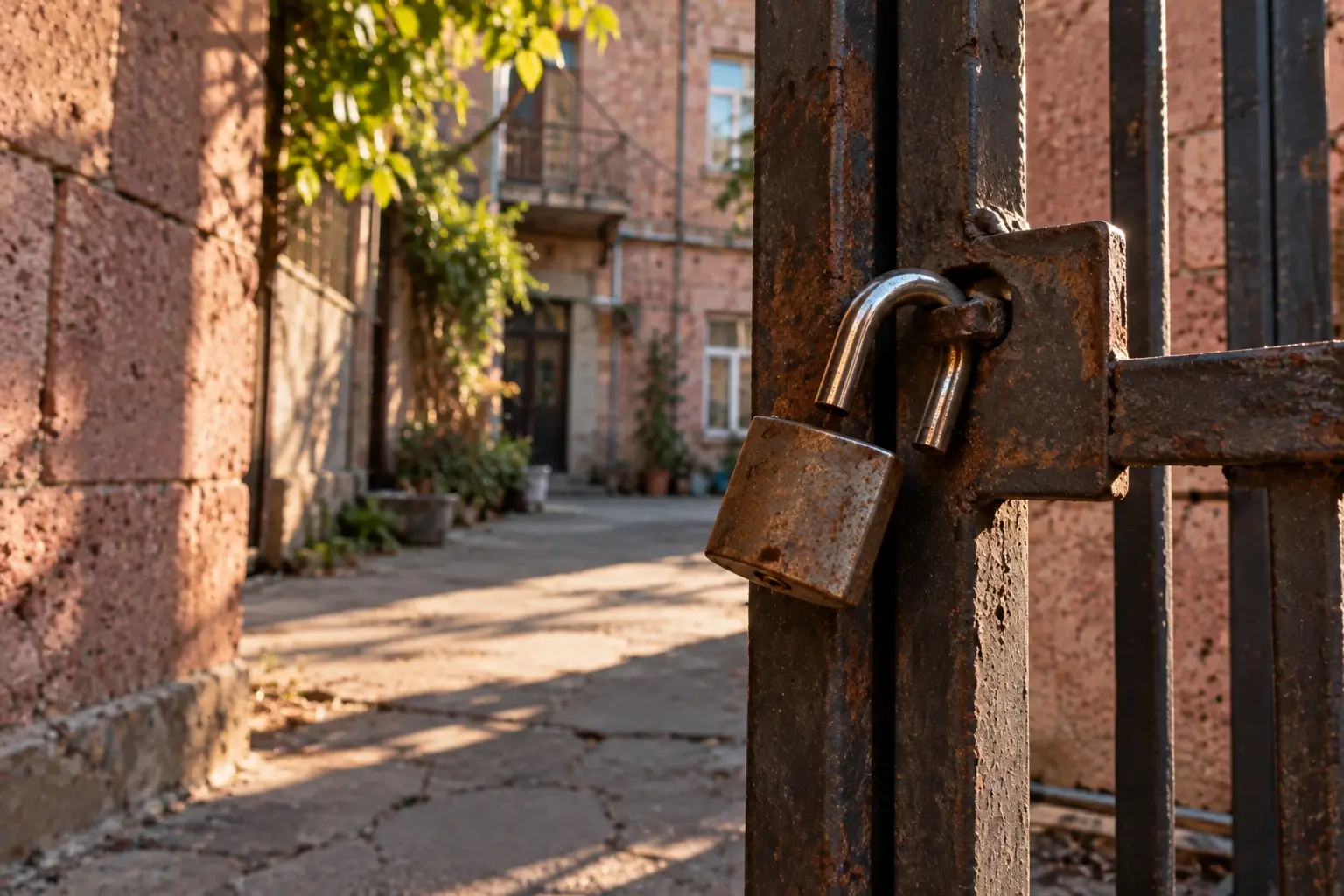
The “Not secure” warning (shown as “Not secure” in Chrome) appears in two cases. Either the site address begins with http://, meaning the connection isn’t encrypted at all, or the site has HTTPS but the certificate has expired or was issued for a different address. You fix this with a certificate. For most sites, it’s free and renews on its own when hosting is set up properly. If you accept cards on your site, the bank needs a certificate as well.
Right now, browsers simply put “Not secure” in the address bar and stop there. Google announced that this is going to change. In an October 2025 article, the company wrote that Chrome 154 (October 2026) will enable “Always Use Secure Connections” mode by default: before a user’s first visit to a public site without HTTPS, the browser will display a prompt with “Continue to site” and “Return” buttons, asking for permission. For users who turned on Enhanced Protection in Safe Browsing, this should start earlier, in Chrome 147 (April 2026). I haven’t checked whether your visitors already have version 154, which is why I wrote “announced” rather than “already live.”
The reason is that HTTP sites have almost vanished. According to that same article, 95% of Chrome page loads on Windows happen over HTTPS, rising to 98% if you look only at public sites. On Linux, the figures are 84% and nearly 97%. On Android, public sites are over 99% HTTPS. A site without HTTPS has become an exception, and that’s precisely why visitors notice it.
If you plan to accept cards on your site, a certificate is part of the bank’s requirements. In Ameriabank’s internet acquiring terms (edition 9, approved on 21.04.2026, effective from 27.04.2026), clause 4.8 requires “modern standards of information protection (encryption) on the website” and a document confirming it—in other words, the certificate. Clause 4.7 requires a separate document confirming domain ownership. The bank doesn’t specify the certificate type in this text. I haven’t checked how other banks handle this. The full list of website requirements is covered in the article on bank requirements for an acquiring website.
Open the site on a phone, type the address with http://, and see what happens. Tap the icon next to the address and check the certificate dates.
| What you see | What happened | What to do |
|---|---|---|
“Not secure”, address starts with http:// | There is no certificate, or visitors aren’t redirected to the secure address | Install a certificate and turn on redirects from http to https |
| Full-screen security warning | The certificate has expired or was issued for a different address | Renew or reissue it, and verify auto-renewal |
Lock icon is there, but some images or scripts load over http:// | Old URLs remain in the code | Replace resource addresses with https:// |
Opens with www, but shows an error without www (or vice versa) | The certificate wasn’t issued for both versions of the address | Issue a certificate for both variants |
Free certificates are issued, for example, by Let’s Encrypt, a non-profit project of ISRG. Its FAQ explains that they don’t charge for certificates, though hosting providers that set them up for clients sometimes charge a small fee. These certificates are valid for 90 days, with renewal recommended every 60 days. It only confirms that the address belongs to the applicant (known as domain validation, or DV). Let’s Encrypt doesn’t issue organization-validated certificates. For sites running across multiple subdomains, there’s a wildcard certificate, which is issued via DNS verification.
Paid certificates can also include organization validation (OV). Local registrar reg.am offers wildcard, DV, and OV certificates; I haven’t checked their prices. For a standard small business site, DV is plenty: visitors see the padlock, and that’s enough. A paid one is needed only when a bank or partner explicitly requires it. So read the exact requirements before buying.
The CA/Browser Forum sets the rules for certificate authorities. A ballot concluded on 11 April 2025, adopting Apple’s proposal, which Google supported. According to DigiCert’s table, maximum certificate lifetimes are shrinking like this:
| Period | Maximum certificate lifetime |
|---|---|
| Until 15 March 2026 | 398 days |
| From 15 March 2026 | 200 days |
| From 15 March 2027 | 100 days |
| From 15 March 2029 | 47 days |
Renewing by hand once a year was still manageable. Nobody renews by hand every 47 days. That means renewal must happen automatically, and renewal emails must reach someone who actually reads them. Ask your host: is auto-renewal turned on? Whose address gets the notices? If it’s the email of a freelancer you haven’t worked with in years, replace it.
http:// and https://, both with www and without. Note what the browser displays.We track domain and certificate dates as part of website maintenance, from 20 000 ֏ per month. If you have your own administrator and auto-renewal works, you don’t need us. If you aren’t sure how things look on your end, send us your website address: I’ll take a look and let you know what I see.
Your site stays online and up to date while you work: monitoring, backups, updates and changes are on us.
Security What Armenian hosts say about backups, what their terms leave out (liability capped at 10,000 and 100,000 ֏), and how to verify your site can be restored.
 Security
What to do in the first hour after a hack, what to ask your hosting provider, how to regain Google's trust, and when to alert your bank if you accept cards.
 Security
If your server password was ever sent over Telegram or Viber, it is no secret. Here is how to switch to SSH keys and revoke access for past freelancers.
Talk to us
Phone us, write to us or send a short brief. You get a clear next step and, after the first conversation, a written estimate.
Animation is off because your system asks for reduced motion.